
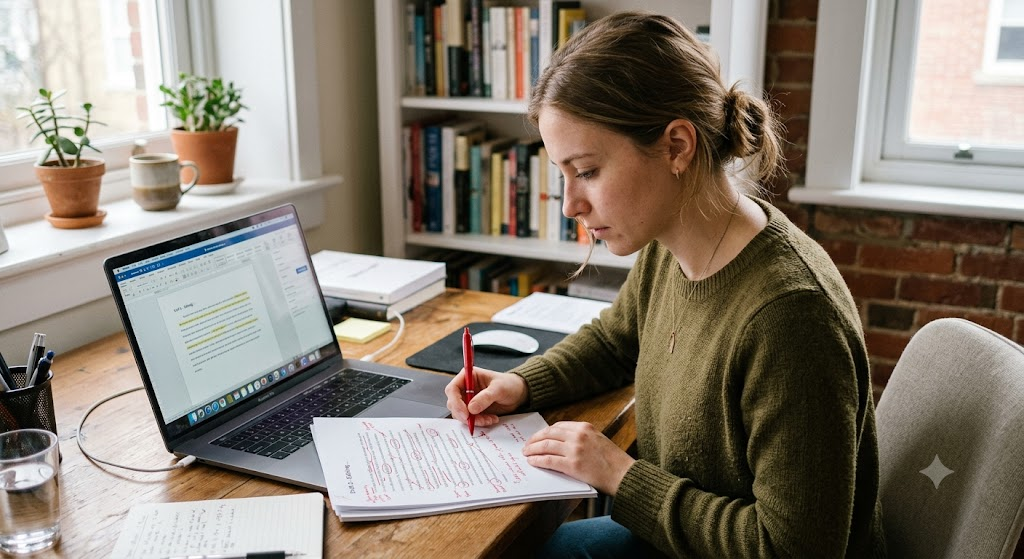

You spot it right after publishing. Of course you do. The sentence looked fine at 11:43 p.m., your cursor was blinking, the page preview felt clean enough, and then the live version suddenly shows a missing word sitting there like it paid rent. You read the same line six times before posting, too. That is the annoying part. Your brain knew what you meant, so it kindly filled in the gap.
Table of Contents
ToggleRead it like someone who owes you nothing
Most grammar mistakes survive because you read your draft like its owner. You already know the point, the rhythm, the little turn you were trying to make. A stranger does not have that loyalty. They trip where the sentence is actually uneven.
The first read should be slow, almost boring
Open the draft and read it at half speed. Not dramatic. Just slower than your normal skim.
You’ll notice weird things when the pace drops. A sentence that starts confidently but never really lands. A verb that changed tense halfway through. A tiny “to” missing before a word, which somehow looked invisible for twenty minutes.
Honestly, this is where most easy fixes show up. Not the clever ones. The ordinary ones.
Your eyes need a different shape
Change the font size, widen the preview window, or paste the draft into a plain document. The words feel slightly unfamiliar, and that helps.
Not magic. Just enough friction.
I’ve always found this slightly irritating, because it proves how much layout tricks your brain. A paragraph can look polished only because the lines break nicely. Then you move it somewhere else and suddenly the grammar mistakes start waving.
Read the last paragraph first
Start from the bottom and move upward, one paragraph at a time. Your brain stops following the argument and starts seeing the sentences.
But the downside is obvious — it feels unnatural, sort of like walking through your house in the dark. Still, that small discomfort helps. You are less likely to glide over a repeated word or a sentence that quietly lost its subject.
The mistakes that hide in plain sight
Some errors do not look like errors. They look like normal writing until the page goes live and the sentence feels off. That is usually the kind that annoys you most, because spellcheck may not complain.
Tense slips are sneaky little things
A draft starts in present tense, then one sentence wanders into past tense because you were thinking about an earlier example. You don’t always catch it because the meaning still works.
For example, “You check the headline, fixed the intro, and move on” feels almost right if you are reading fast. The problem sits in the middle, pretending to belong.
Read for verbs only once.
Missing words love short sentences
Short sentences look safe. They are not always safe.
“Make sure headline matches the article” is understandable, but the missing “the” still makes the line feel rushed. Same with “before you publish” becoming “before publish” because your fingers skipped ahead. The reader may not stop, but they feel the bump.
Homophones do not care how careful you are
Your and you’re. Then and than. Affect and effect.
Everyone knows these, which is maybe why people get embarrassed by them. To be fair, knowing the rule and catching the mistake at speed are not the same thing. Your brain is busy with meaning, not courtroom-level spelling evidence.
If you’ve been staring at a draft for two hours, even obvious words start looking innocent.
Let a tool be the boring second pair of eyes
A careful read should come first, because you still understand tone better than any tool. After that, running the draft through a grammar checker can catch the dull stuff you missed while you were thinking about flow, structure, or whether the intro sounded too stiff.
And yes, you still have to decide. A suggestion can be technically neat and still not sound like you.
Give the draft some air before you trust it
A draft changes when you leave it alone. Not actually, obviously. But your relationship with it changes, and that might be the whole trick.
Ten minutes can be enough
You do not always need a full day away from the piece. Sometimes ten minutes is enough if you actually stop looking at it.
Stand up. Refill water. Open a window. Do something boring.
When you return, your eyes are less committed to defending the old version. You catch a doubled “the,” an awkward comma, or that sentence where you used “publish” twice in five words.
Read it out loud, even quietly
The mouth catches what the eye forgives.
If a sentence is missing a word, your voice often hesitates. If the punctuation is strange, you hear yourself breathing in the wrong place. Weirdly enough, this works even if you whisper it like you are trying not to disturb anyone.
A line can be grammatically fine and still sound wooden. That is not exactly a grammar issue, but it matters before publishing.
Check the headline after the body
The headline is usually written early, then the article changes. By the end, the headline might still be correct, but slightly off.
Maybe the article became more practical than you planned. Maybe it turned into a small rant about proofreading habits. Maybe the title promises “grammar mistakes,” and half the draft talks about clarity instead.
That mismatch is easy to miss because the headline feels separate from the writing.
Watch the last-minute edits
A surprising number of mistakes arrive after the “final” proofread.
You change one phrase, remove a sentence, tighten the ending, and suddenly two words that used to connect no longer do. At some point, you have to proofread the edited sentence, not the memory of the sentence before it.
I wish more people talked about this part.
Before you hit publish
The final check should feel a little suspicious. Not panicked. Just suspicious enough that you do not trust the draft too easily.
Look at the places where mistakes usually gather: headings, first lines after headings, captions if you have them, and any sentence you rewrote more than once. Those spots carry fingerprints. They often show where the draft changed direction.
Do one pass only for small words. Articles, prepositions, repeated words, tense. It feels fussy, and maybe it is, but those are the errors that make a clean page feel careless.
Then publish when it feels ready enough, not perfect. You will still spot something later now and then. Everyone does. The aim is not to become the kind of person who never misses anything. The aim is to miss less, and to notice your own habits before they keep following you into the next draft.