
Food photography strategies can transform ordinary dishes into scroll-stopping visual content. Whether someone shoots for a restaurant menu, a food blog, or social media, the right techniques make all the difference between a forgettable snapshot and a mouthwatering image.
Great food photography combines technical skill with creative vision. It requires an understanding of light, composition, styling, and post-processing. The good news? These skills are learnable. This guide breaks down the essential food photography strategies that professionals use to create images that make viewers hungry.
Table of Contents
ToggleKey Takeaways
- Natural light, especially soft window light on overcast days, is the most effective lighting strategy for appetizing food photography.
- Use the rule of thirds, odd-numbered groupings, and leading lines to create visually compelling food compositions.
- Choose props and backgrounds that support your dish without stealing attention—dark surfaces suit comfort food while light backgrounds work for fresh fare.
- Control depth of field with aperture settings: wide apertures (f/1.8–f/2.8) isolate dishes, while narrower apertures (f/8–f/11) keep flat-lay shots sharp.
- Always shoot in RAW format to maintain editing flexibility for white balance, exposure, and color corrections.
- Polish your food photography with careful post-processing—adjust white balance, boost clarity for texture, and remove distracting elements.
Understanding Light and Its Impact on Food
Light is the single most important element in food photography strategies. It shapes how textures appear, how colors pop, and whether a dish looks appetizing or flat.
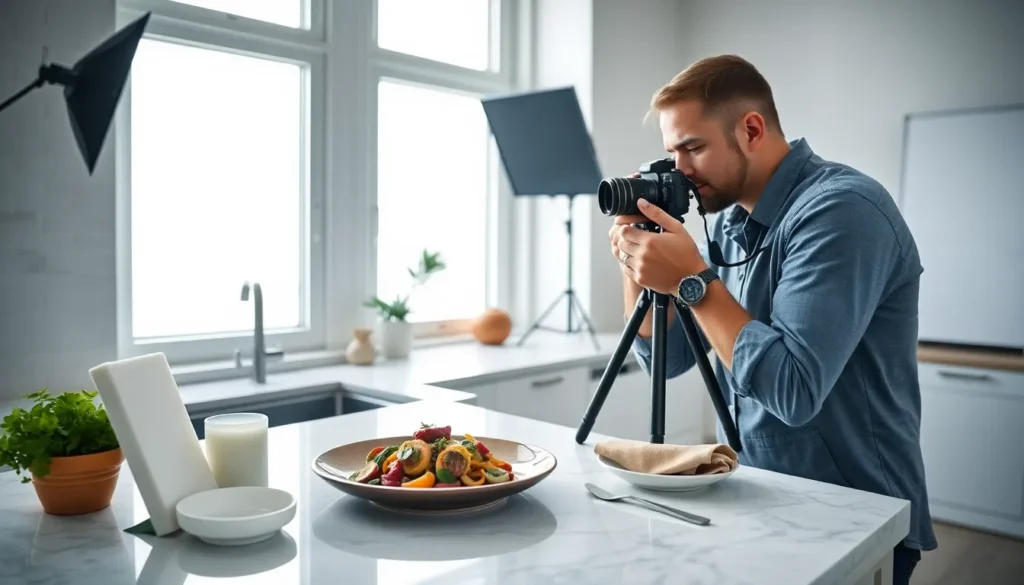
Natural light remains the gold standard for most food photographers. Window light, particularly on overcast days, creates soft, even illumination that flatters food. Position the dish near a large window and watch how the light wraps around it. Side lighting (light coming from the left or right) emphasizes texture, think crusty bread or glistening sauce. Backlighting creates a luminous quality that works beautifully for beverages and translucent foods like honey or citrus slices.
Harsh direct sunlight creates problems. It produces strong shadows and blown-out highlights that distract from the food. Diffusers solve this issue. A simple white curtain or professional diffusion panel softens harsh rays into workable light.
Reflectors bounce light back into shadow areas. White foam board is cheap and effective. Gold reflectors add warmth, while silver ones create a cooler, more contrasty look.
Artificial lighting offers consistency when natural light isn’t available. Continuous LED panels let photographers see exactly what they’re getting. Softboxes mimic the quality of window light. The key is matching the color temperature to avoid unnatural color casts on food.
Mastering Composition and Styling Techniques
Strong composition separates amateur food photos from professional work. Food photography strategies for composition start with understanding a few foundational rules.
The rule of thirds places the main subject off-center for visual interest. Imagine a grid dividing the frame into nine equal sections. Position key elements along these lines or at their intersections.
Odd numbers work better than even ones. Three cookies look more dynamic than four. Five strawberries create more visual tension than six. The human eye finds odd groupings more interesting.
Leading lines guide the viewer’s eye toward the main subject. A knife pointing toward a steak, a trail of crumbs leading to a pastry, or the curve of a plate’s edge, these elements create visual pathways.
Negative space gives food room to breathe. Cluttered frames overwhelm viewers. Leave empty areas around the main dish to draw attention where it belongs.
Styling involves the physical arrangement of food. Fresh herbs add color pops. Drizzles of sauce create movement. Steam suggests freshness and warmth (though it’s notoriously difficult to capture). Professional food stylists often use glycerin for fake water droplets and motor oil as a stand-in for maple syrup because it doesn’t absorb into pancakes.
Angle selection matters enormously. Flat-lay shots (directly overhead) work well for pizzas, salads, and table spreads. A 45-degree angle suits most plated dishes. Straight-on shots highlight layers in burgers, cakes, and sandwiches.
Choosing the Right Props and Backgrounds
Props and backgrounds support the food without stealing attention. Smart food photography strategies treat these elements as supporting actors, not stars.
Backgrounds set the mood. Dark, moody surfaces work for comfort food and evening dishes. Light marble or white wood suits fresh, bright fare. Textured surfaces add depth, weathered wood, linen tablecloths, or concrete slabs create visual interest.
Props should tell a story. A cup of coffee beside a slice of cake suggests an afternoon treat. Scattered flour around fresh bread implies it was just baked. Raw ingredients in the background connect the finished dish to its origins.
Color theory guides prop selection. Complementary colors (opposites on the color wheel) create contrast. Orange dishes pop against blue backgrounds. Green herbs stand out on red plates. Analogous colors (neighbors on the wheel) produce harmony and calm.
Scale matters. Oversized props dwarf the food. Tiny accessories get lost. The dish should always dominate the frame.
Build a prop collection gradually. Thrift stores offer vintage plates, utensils, and linens at low prices. Restaurant supply stores carry professional-quality items. Fabric stores provide backdrop materials.
Camera Settings and Equipment Essentials
Technical knowledge elevates food photography strategies from good to great. Understanding camera settings gives photographers control over their final images.
Aperture controls depth of field. Wide apertures (f/1.8 to f/2.8) create shallow focus with blurry backgrounds, perfect for isolating a single dish. Narrower apertures (f/8 to f/11) keep more elements sharp, ideal for flat-lay shots where everything should be in focus.
ISO should stay as low as possible to minimize grain. ISO 100-400 works best. Higher ISOs introduce noise that degrades image quality.
Shutter speed matters less for stationary food but becomes critical when capturing pouring liquids, falling ingredients, or steam. Speeds of 1/250 or faster freeze motion effectively.
A tripod is essential equipment. It enables sharp images at slow shutter speeds and ensures consistent framing between shots. This consistency speeds up editing later.
Lens choice affects the look dramatically. A 50mm lens produces natural-looking images. An 85mm or 100mm macro lens compresses the background and captures fine details. Wide-angle lenses distort food and rarely flatter it.
Shoot in RAW format rather than JPEG. RAW files contain more data, allowing greater flexibility during editing. White balance errors, exposure issues, and color problems are all easier to fix in RAW files.
Editing Tips for Polished Final Images
Post-processing completes the food photography strategies workflow. Editing transforms good captures into stunning final images.
Start with white balance correction. Food should look natural, not too warm or too cool. Adjust until whites appear truly white and colors look accurate to real life.
Exposure adjustments brighten dark images or recover blown highlights. Most food photos benefit from slightly brighter exposure than other genres. Bright images feel fresh and appetizing.
Contrast and clarity add punch. Increase contrast modestly to separate the food from its background. The clarity slider enhances texture, use it carefully on food to avoid an over-processed look.
Saturation and vibrance boost colors. Vibrance affects muted tones more than already-saturated ones, making it safer for food photos. Push saturation too far, and food starts looking artificial.
Spot removal eliminates distractions. Crumbs in wrong places, fingerprints on plates, dust specks, these details escape notice during shooting but scream for attention in final images.
Cropping tightens composition. Sometimes the best version of a shot lives inside a larger frame. Crop to strengthen leading lines, improve rule-of-thirds placement, or remove edge distractions.
Presets speed up workflow but require customization. A preset that works perfectly on a bright salad may fail completely on dark chocolate cake. Treat presets as starting points, not final solutions.